Sunday, 22 November 2015

Pontifical Low Mass, Church Street, Dublin 7

On Saturday, 21st November, 2015, His Grace the Archbishop of Dublin honoured our Association by celebrating a Pontifical Low Mass for the feast of the Presentation in the Capuchin Church, Church of St. Mary of the Angels, Church Street, Dublin 7.  The choir of the Augustinian Church, John's Lane, lent great beauty to the ceremonies with their singing.  The Capuchin Community opened their doors and extended great hospitality to us for the use of the Church for Holy Mass, their refectory for refreshments afterwards, catered by the nearby Cinnemon Café.

Afterwards the Annual General Meeting of the Catholic Heritage Association of Ireland was held jointly with the first General Meeting of St. Laurence's Catholic Heritage Association.  Immediately following the election of our Committee, Judge Peter Smithwick introduced a talk by Lord Gill, retired Lord President of the Court of Session of Scotland.  Afterwards, Judge Smithwick made presentations to some of the members of the Assocation for distinguished service over the years.  The afternoon concluded with Benediction of the Blessed Sacrament given by Fr. Padraig, O.F.M.Cap.


Wednesday, 18 November 2015

The Archiepiscopal See of Dublin (c. 750 - 1161)(Walsh)


From Walsh's History of the Irish Hierarchy, 1854, c. xvi, p. 106 ff:

St. Sedulius son of Luaith is called bishop and abbot of Dublin as those were synonymous terms. Many abbots distinguished by their merit were promoted to the episcopacy without having sees attached to their places of residence. Such was his neighbor and contemporary the abbot and bishop Ferfugill of Clondalkin. Offices perfectly distinct were thus vested in the same person as it was necessary that episcopal functions should be exercised within the precincts of monastic establishments too remote from a regularly fixed see.

Besides assistant bishops such as coadjutors there were in Ireland others of a more subordinate dignity. Of this latter description the annals of Ireland make mention. To minister more effectually to the spiritual wants of his flock who might have dwelt at a distance from the abode of the bishop it was sometimes deemed prudent to remedy such an inconvenience by selecting priests in the remote districts to whom was confided the care of the faithful and that such clergymen were invested with a sort of episcopal jurisdiction appears certain but whether dignified always with the holy order of the episcopate is a question as yet to be decided. Some maintain it as the more probable that they were not exalted to this dignity others allow that they were consecrated and that they could with the permission of the ordinary confer the orders of deaconship and the priesthood. Other writers hold the opinion that they were always and without exception invested with the order of the episcopacy.

In Ireland, the usage of conferring consecration on those ecclesiastics appears to have been generally adopted. In the early annals of the kingdom they are represented as persons belonging to the episcopal order such an ecclesiastic as we treat of is honored with the appellation of bishop and among the Irish as there was but one name for bishops and chorepiscopi it is often difficult to determine whether this class of ecclesiastics were the ordinaries of sees or the subordinates. If we find mention of bishops who discharged episcopal functions in different dioceses or provinces we are to suppose that they acted in the capacity of assistants as the discipline of the Church obliged the ordinary of each see to exercise the duties of his order within the limits of his own diocese.

Cormac was living in 890 When Dublin was besieged by Gregory king of Scotland and the inhabitants were reduced to extremity Cormac a man of singular virtues and of upright life was deputed to lay before the king of Scotland the distressed state of the city. The King absolutely refused to extend any hope until the city was surrendered to his discretion and on being given up he forthwith advanced on foot till he came to the bishop and falling down on his knees he reverently kissed the crucifix which the prelate bore and ratified the wishes of the bishop.

Donatus was the first amongst the Ostmen or Danes who was bishop of Dublin. By some he is called Dunan. He built by the aid of Sitricus the cathedral of the Holy Trinity in the heart of the city of Dublin about the year 1038 to which Sitric gave considerable landed possessions. Donatus lived to an advanced age died on the 6th of May 1074 and was buried in his own cathedral in the upper part of the chancel on the right.

Patrick called in the Annals of the Four Masters Giolla Patricianus was elected bishop of Dublin at the instance of Gotred king of the Isle of Man who conquered Dublin and the adjacent country. He was sent to England to receive consecration from Lanfranc archbishop of Canterbury with an epistle to the following effect. "To Lanfranc the venerable metropolitan of the Holy Church of Canterbury the clergy and people of Dublin tender their bounden obedience. It is known unto your fatherhood that the Church of Dublin the metropolis of Ireland is bereft of her pastor and destitute of her ruler. Wherefore we have elected a priest called Patrick a person whom we thoroughly know one noble both by birth and morals well imbued in apostolical and ecclesiastical discipline in faith a Catholic and in the interpretation of Scripture wary in the tenets of the Church well versed and whom we desire without delay to be ordained our bishop that under God he may rule over us orderly and profit us and that we under his government may exercise a spiritual warfare with security. Because the integrity of the ruler is the safety of the subject and where safety of obedience is there is the sound form of doctrine."

Patrick was consecrated and made unto Lanfranc promise of submission and obedience in all things pertaining to the Christian religion. Patrick was an Ostman and the Danes of the sea ports being more inclined to attribute their conversion to the Anglo Saxons than to the Irish and who moreover considered William the Conqueror and the Normans their countrymen did not deem it politic to have their bishops derive their sanction from the see of Armagh hence they applied to the English primate for the consecration of their bishops. Patrick governed the see about ten years and being sent to England by King Turlough on business to Lanfranc perished by shipwreck on the 10th of October 1084.

Donat O'Hanly succeeded by similar authority as his predecessor was consecrated by Lanfranc AD 1085. Having spent some time in the pursuit of useful learning in Ireland he passed over to England and became a Benedictine monk at Canterbury. With Lanfranc to whom he also made profession of obedience Donatus was a particular favorite he gave him several presents books and church ornaments for his cathedral. This prelate died of a plague in 1095 leaving a reputation among his countrymen for industry learning and sagacity.

Samuel O'Hanley, nephew of Donatus succeeded AD 1095 by similar authority; was also a Benedictine; obtained from Lanfranc vouchers of his consecration. Soon after his return to Ireland he expelled some monks from the cathedral of the Holy Trinity stripped the church of the books and ornaments which the archbishop of Canterbury had bestowed on it and commanded the cross to be carried before him Lanfranc laving heard of those doings remonstrated with the bishop of Dublin and desired Malchus, bishop of Waterford to expostulate with him. Samuel died on the 4th of July AD 1121.

Gregory the First, archbishop of Dublin, was elected in 1121 and went to England to receive consecration from the archbishop of Canterbury. He brought letters from the king in his favor and also from the clergy and people of Dublin in which it was notified that the bishops of Ireland, particularly the primate of Armagh, had taken great hatred towards them because they would not obey the orders of the said bishops but showed themselves always willing to live under the jurisdiction of the see of Canterbury. He was consecrated at Lambeth by Ralph, archbishop of Canterbury, and made the usual profession of obedience to him.

Having presided over the see of Dublin thirty one years the archiepiscopal dignity was conferred upon him at the council of Kells held under John Paparo legate from the Holy See in 1152. The distribution of sees has been already noticed in the life of St. Malachy of Armagh and the names of the bishops who attended are also enumerated. Besides the bishops there were three thousand ecclesiastics present at this synod though at this synod were men of acknowledged sanctity and ecclesiastics of unblemished character though the purity of the native priesthood of Ireland was above reproach a fact to which Gerald Barry reluctantly assents and one which is particularly avowed in the thirteenth canon of the council held by Archbishop Comyn in 1186 bearing testimony to the chastity for which the Irish clergy were always remarkable. Moore in his History of Ireland draws an inference from a canon of this synod enacted against marriages in the prohibited degrees of kindred unfavorable to the Irish clergy and that they assimilated themselves to many of the clergy on the Continent who disregarded the salutary discipline of celibacy. The conduct of the lay usurpers of the see of Armagh has left the imputation on this see alone and it is worthy of notice that the Irish annals do not record instances of profligacy among the priesthood of Ireland until the adventurers of England introduced their system of morals. The Archbishop Gregory died on the 8th of October AD 1161 having sat forty years. He was a wise man and well skilled in languages.

Monday, 14 September 2015

Sunday, 13 September 2015

Mass for the Holy Name of Mary

On 12th September, the monthly exercises of the Sodality of Our Lady took place in St. Joseph's Church, Berkeley Road, Dublin 7. A Latin Mass for the feast of the Holy Name of Mary was offered.


Thursday, 3 September 2015

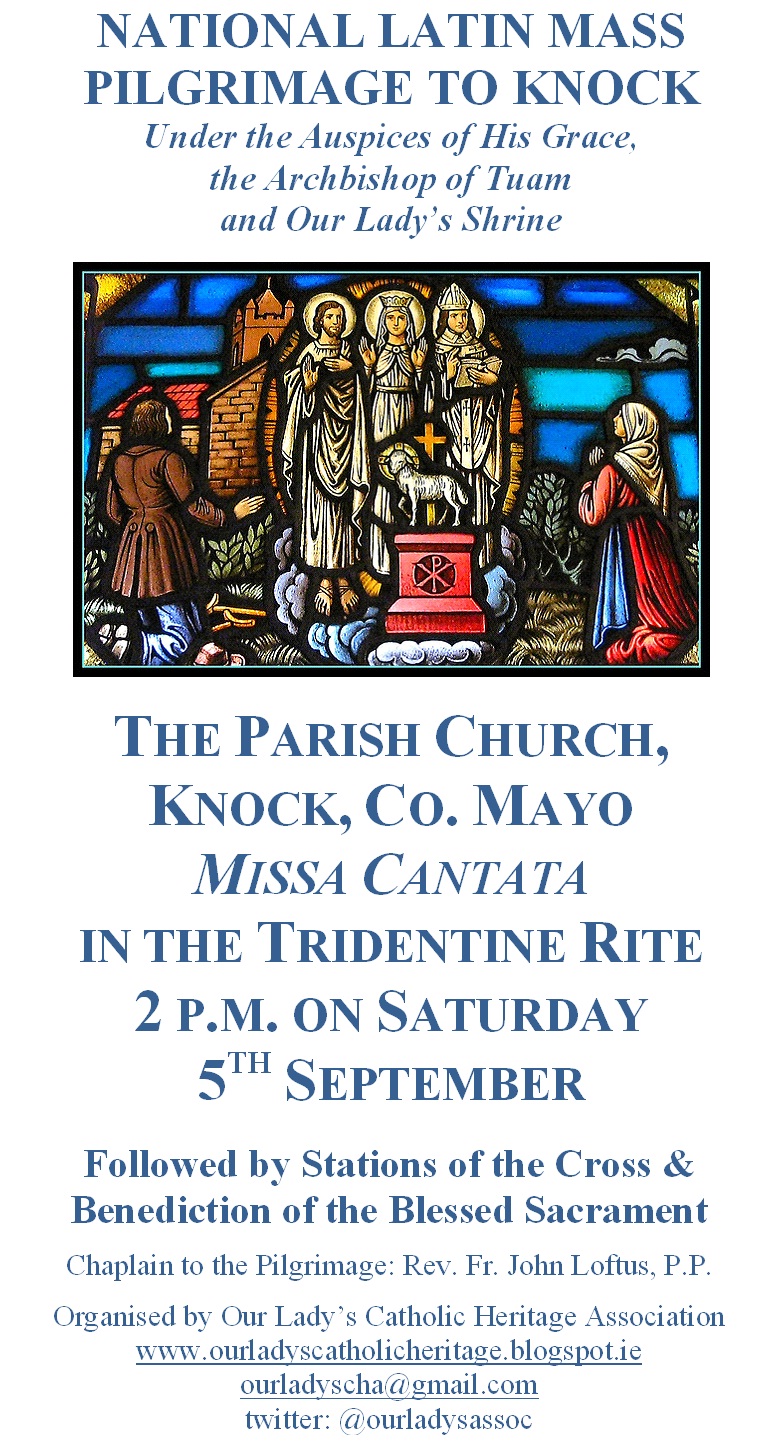
Latin Mass Pilgrimage to Wicklow Town

St. Patrick's Church, is set strikingly on a hill overlooking the scenic and historic coastal town of Wicklow.  Although the area has been populated for thousands of years, the town itself was settled by the vikings about the year 800.  To that extent, it is older even than Dublin City.  The Irish name Cill Mhantáin, or Church of the toothless, is replaced by the Norse Vikló, or harbour of the meadow.
 
The town would have found itself in the Gaelic Diocese of Glendalough, which extended across the whole of what is now the Archdiocese of Dublin.  Viking Dublin did not have a Bishop until Donatus was consecrated in 1038.  At the Synod of Rathbreasail in 1118, Dublin is not mentioned.  At the Synod of Kells in 1152, the Diocese of Glendalough was divided, giving the northern portion of its territory to Dublin, which also received a Metropolitan pallium.  Gregory became the first Archbishop of Dublin and was succeeded by St. Laurence O'Toole.  In 1185, King John decreed the union of Glendalough to Dublin but it wasn't sanctioned by the Pope until 1216.
 
In the valley between the Catholic Church and Anglican church and at the medieval town gate lie the ruins of a Franciscan Abbey, built about the year 1265.  Only elements of the south transept and nave are visible today.
 
As already noted in the post on the pilgrimage to Bray, the facade of the Church is remarkably similar to that of the original facade of the Church of the Holy Redeemer, Bray, and to other Churches by W.H. Byrne.  It was completed about 1840 to an unknown architect's design, where there is a gap in Byrne's list of works.  Therefore, it may cautiously be attributed to him. 
 
Members and friends of St. Laurence's Catholic Heritage Association made a pilgrimage there on Saturday, 22nd August, including a Mass celebrated by a Priest of the Diocese.
 

Wednesday, 15 July 2015

A Timeline of St. Laurence O'Toole


1128 - Born in Castledermot, Co. Kildare
1154 - Became Abbot of Glendalough to succeed Abbot Dunlaing
1161 - First Native Irish Archbishop of Dublin
1162 - Consecrated Bishop by Galesius, Archbishop of Armagh
1163 - Established the Canons Regular of Arouasia at the Cathedral of the Most Holy Trinity
1166 - Established the Priory of All Hallows of the Canons Regular of Arouasia
1167 - Attended the Council of Athboy
1170 - Presided as Papal Legate at the Council of Clonfert
1171 - Visited Henry II in Normandy, violently attacked while processing to Mass
1172 - Attended the Synod of Cashel
1175 - Negotiated the Treaty of Windsor
1176 - Presided at the funeral of Strongbow
1178 - Synod of Dublin presided over by Cardinal Vivian as Papal Legate
1179 - Attended the Third Lateran Council under Pope Alexander III
1180 - Died at Eu in Normandy
1225 - Canonised by Pope Honorius III
1227 - The body of St. Laurence enshrined at Eu

Friday, 10 July 2015

Traditional Latin Mass in Bray, County Wicklow

This is the first occasion on which our Association has made a pilgrimage to Wicklow, the Garden of Ireland. On 4th July, we made a pilgrimage to Bray for a Traditional Latin Mass in the Church of the Holy Redeemer on the Main Street. Building upon the existing Chapel of c. 1824, our old friend Patrick Byrne enlarged the Church and added a tower and facade strikingly similar to St. Patrick's, Wicklow Town (c. 1844) and to Byrne's St. John's, Blackrock (c. 1845).  W.H. Byrne further enlarged the Chapel into the present envelope, a Romanesque Church with colonnaded transepts and an apsidal Sanctuary c. 1894-1898, for Most Reverend Nicholas Donnelly, D.D., P.P., V.G., then Parish Priest of Bray and Greystones, Bishop of Canae and Auxiliary Bishop of Dublin.  Presumably at the same time as the modernist facade was added (1965) the sanctuary was re-ordered and the organ erected in the apse.


Tuesday, 30 June 2015

Ad Multos Annos Your Eminence


To His Eminence, Raymond Leo, Cardinal Burke,  Cardinal Patron of the Sovereign Order of Malta, Prefect Emeritus of the Apostolic Signatura, Cardinal Deacon of S. Agata dei Goti, we wish a very happy birthday!

Tuesday, 23 June 2015

The Fall of Fort St. Elmo

The Fall of Fort St. Elmo

On this the 450th anniversary of the fall of Fort St. Elmo I am re-posting an article from 2009.

What these few knights, soldiers and civilians withstood for a horrifying month is nothing short of miraculous. Below is an excerpt of a talk given by Michael Davies in 2002 that was part of a conference given at the Dietrich von Hildebrand Institute 2002 Summer Symposia entitled “The 1st Through 8th Crusades; Military Orders; Catharist Crusade; and the Siege of Malta.” The full article can be read here, it describes some of what they went through during that month.

Mustapha finally acknowledged that St. Elmo could not be taken within that day and ordered the recall. St. Angelo's suddenly heard a burst of cheering from their brothers in St. Elmo. They had lost 200 men in the battle, in comparison to 2,000 Turks. But they knew the end was near, for there would be no more reinforcements.

St. Elmo's men readied themselves for a fight to the death. The two chaplains who had stayed with the defenders throughout the siege confessed the remaining knights and soldiers. Determined that the Mohammedans would not have the opportunity to mock or desecrate their holy relics, the knights and the chaplains hid the precious objects of the Faith beneath the stone floors of the chapel, and dragged the tapestries, pictures and wooden furniture outside and set them on fire
. They then tolled the bell of the small chapel to announce to their brethren in the nearby forts that they were ready for the end.

In the gray pre-dawn light of the 23rd of June, Piali's ships closed in for the kill. The galleys, pointing their lean bows at the ruined fort, opened up their bow chasers in unison with the first charge made by the entire Turkish army. To the astonishment of Mustapha and his council, Fort St. Elmo held for over an hour. Less than 100 men remained after that first onslaught, yet the Ottoman army was forced to draw back and re-form. The knights who were too wounded to stand placed themselves in chairs in the breach with swords in their hands.

There was something about the next attack that told the garrisons looking on from Birgu and Senglea that all was over. The white-robed troops poured down the slopes, hesitated like a curling roller above the wall, and then burst across the fort, spreading like an ocean over St. Elmo. One by one the defenders perished, some quickly and mercifully, others dying of wounds among the bodies of their friends.

The Italian Knight Francisco Lanfreducci, acting on orders received before the battle began, crossed to the wall opposite Bighi Bay and lit the signal fire. As the smoke curled up and eddied in the clear blue sky, La Valette knew that the heroic garrison and the fort they had defended to the end were lost.

It was now that Mustapha Pasha impatiently strode to view his conquest. A standard-bearer carrying the banner of Sultan Suleiman the Magnificent stepped through the breach into St. Elmo. Standing victorious on the ruins of St. Elmo's walls, with the flag of St. John in the dust at his feet, Mustapha gazed at the massive bulk of Fort St. Angelo on the horizon. “Allah!” he cried. “If so small a son has cost us so dear, what price shall we have to pay for so large a father?”

In an offensive act of cruelty, he ordered the bodies of the knights to be set apart from the common soldiers. Their heads were struck from their bodies and fixed on stakes overlooking Grand Harbor. The beheaded corpses were then stripped of their mail, nailed to crossbeams of wood in mockery of the crucifixion, and launched onto the waters of Grand Harbor that night.

It was the eve of the Feast of St. John, the patron saint of the Order. Despite the loss of St. Elmo, the Grand Master had given orders for the normal celebrations to take place. Bonfires were lit and church bells were rung throughout Birgu and Senglea. The next morning the headless bodies of the knights washed up at the base of Fort St. Angelo.

Image  THE CAPTURE OF FORT ST. ELMO by Mateo Perez d’Aleccio

Monday, 22 June 2015

The Last Day Before the Fall of St. Elmo

From an account of the Great Siege of Malta from the Malta Heritage Site. On the day before the fall of Fort St. Elmo the remaining 100 defenders, without ammunition, their leaders dead and themselves half dead from exhaustion and their own wounds prepared themselves for the final battle.

As the hours passed and no relief came, the survivors in Fort St Elmo realized that no help was going to come to them. With this bitter recognition, they resigned themselves to their fate and they started to comfort each other through these agonizing moments. They were determined to die in the service of Jesus Christ and although they were half dead from fatigue, they never rested but worked to improve their defences.
This was surely a dreadful time for our men and to make things worse, the enemy spent the whole night bombarding them, sounding the alarm and skirmishing. Clearly, they did so in order to break down the defenders so that by morning, they would be completely worn out.
As their end seemed to get closer by the hour, the last defenders of Fort St Elmo confessed to each other and implored Our Lord to have mercy on their souls for the sake of the blood that He had shed for their redemption.